Tag: stageplay

  • Review: The Words Will Come created by Melody Erfani (LES Shakespeare Co., PDX)

    Review: The Words Will Come created by Melody Erfani (LES Shakespeare Co., PDX)

    When I see friends’ shows with the intention to review, I try to go in as objectively as possible. I will preface this review by saying I’ve read a previous draft of The Words Will Come created by Melody Erfani; what I saw on Saturday, June 6th in Portland proved how much it takes a team like the one Erfani pulled together to create a brilliant show full of heart and intention.

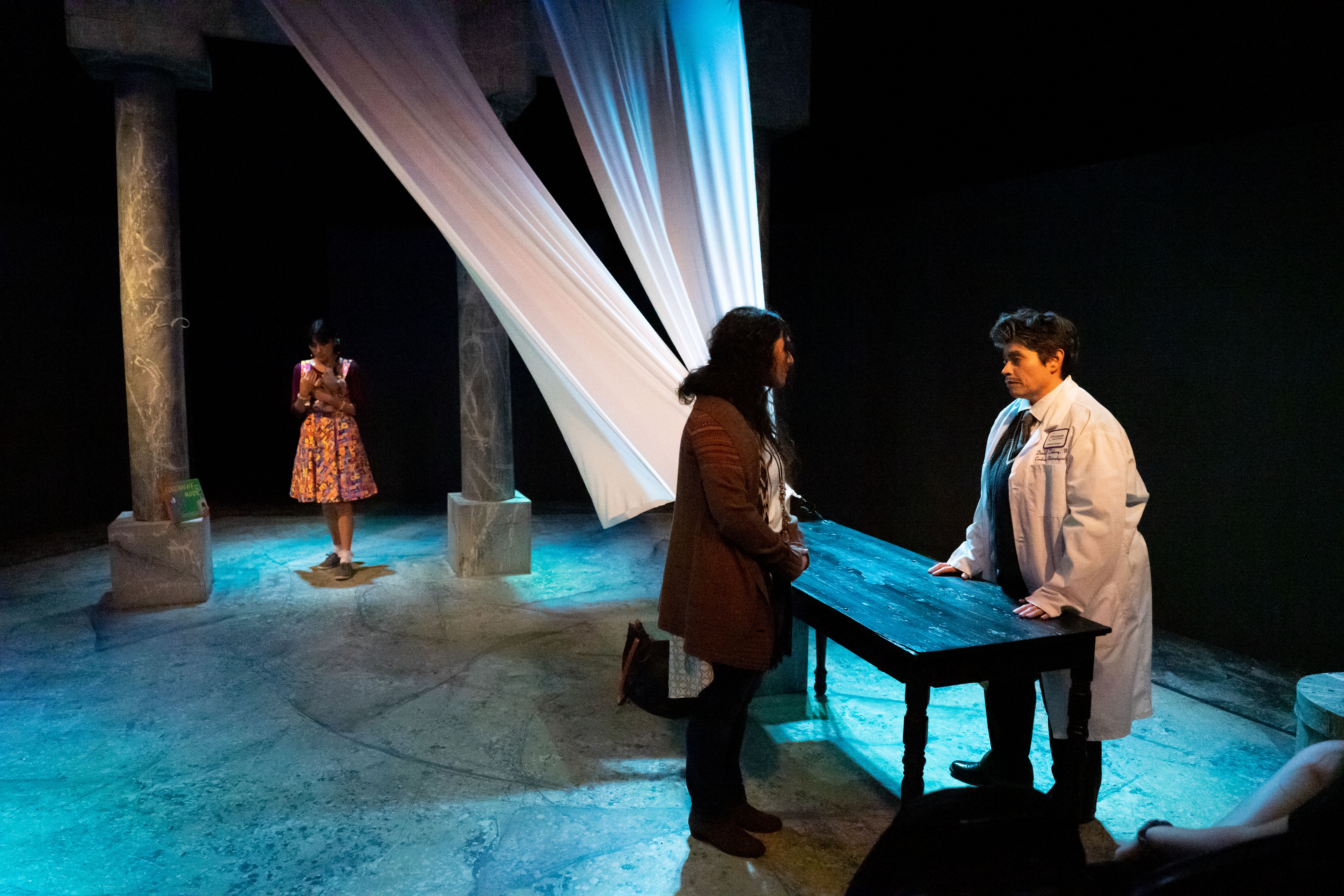
    Amy Driesler (Einstein), Alex Abdelwahed (Sheila), Kelly Saunders (Lala) (left to right).
    Photo by Kyra Sanford

    The Words Will Come blends movement in a dreamscape depicting dyslexia, identity, and searching for one’s voice and belonging. It was inspired in part by Erfani’s own experience with dyslexia as a child, as well as witnessing her niece’s decades later. Erfani was particularly struck by how little structures and institutions have changed in their approach to dyslexic and neurodivergent students. Prior to its world premiere at Shaking the Tree Theatre, Erfani developed the piece at HB Studio in 2024 and the Alembic Residency earlier this year with a slew of collaborators. 

    Immediately upon entering the space, the audience is encouraged to engage with the lobby display about a word that comes to mind about ourselves. There is also a plethora of local and state-wide resources available and some cool swag. I enjoyed being able to be creative and engage in some preshow reflection about dyslexia. It coalesced into a collaborative lobby piece where your word joined others’ to create a new piece of art. 

    Kelly Saunders (Lala), Alex Abdelwahed (Sheila), Amy Driesler (Einstein) (left to right)
    Photo by Kyra Sanford.

    Erfani’s directing shines once again with a clear vision of storytelling in such a movement-driven piece and in a piece that exists in a more corporeal setting than reality. The set design by Kyra Sanford is sleek and simple, there to accentuate the actors’ interactions and movement and put them on display as if a museum exhibit. Three white columns stand center stage with curtains that are utilized throughout the show to create different scenes, to entrap actors and embody their inner worlds, and to project letters and words onto. Rachel Kinsman Steck’s lighting design and Alan Cline’s projections move seamlessly across the walls of the blackbox and Sanford’s scenery, creating a suffocating feeling that proved most effective when Sheila (our young protagonist played by Alex Abdelwahed) struggles with her dyslexia. 

    Kelly Saunders (Lala), Alex Abdelwahed (Sheila), Amy Driesler (Einstein) (left to right)
    Photo by Kyra Sanford.

    Abdelwahed’s Sheila is endearing, earnest, and fully grounded. She is the life and soul of the piece, bringing together Lala (her older counterpart played by Kelly Saunders) and the one and only Albert Einstein (played by Amy Driesler). Saunders expertly captures the darkness that surrounds an adult losing control of her life as she faces a potential divorce from her wife and as she must relive her childhood memories dealing with dyslexia. Also, major props to Saunders for doing at least three different accents while embodying different characters in Sheila’s world. Driesler’s Einstein surprised me, portraying Einstein not just as the genius we think he was but also embodying him as a full person with a variety of ideas, faults, and emotions. I was really tickled by Einstein playing one of Sheila’s classmates and also Einstein’s soap opera marriage directed by Sheila herself. The three actors work together in the movement portions of the play to create moments of frustration, confusion, fear, love, and acceptance. 

    Amy Driesler (Einstein), Alex Abdelwahed (Sheila), Kelly Saunders (Lala) (left to right).
    Photo by Kyra Sanford.

    I also really enjoyed the moments with Sheila and her mother (also played by Saunders), where their Iranian heritage was subtly present and wholly unapologetic. The “happy birthday” song, followed by Sheila’s unsuccessful wish to know how to read Good Night, Moon and her mother comforting her brought tears to my eyes. In addition, Lala’s casual queerness and her vulnerability around her unraveling relationship with her wife was touching and felt real and organic. As a neurodivergent person, this show made me feel seen. I absolutely adored The Words Will Come and would whole-heartedly see it again. This is what it means to make space for everyone in theatre and storytelling. 

    Kelly Saunders (Lala), Alex Abdelwahed (Sheila) (left to right).
    Photo by Kyra Sanford.

    Performance Details

    THE WORDS WILL COME: Inside the Dyslexic Mind
    Created and directed by Melody Erfani

    When: now through June 28, 2026
    Thursdays–Saturdays at 7:30 PM
    Sundays at 2:00 PM

    *On Saturday, June 20, the show is bringing together educators, dyslexia advocates, immigrant and refugee support organizations, and community leaders for a post-show conversation about belonging, stigma, support systems, and what it means to feel seen. Featuring representatives from: International Dyslexia Association – Oregon, Pacific Refugee Support Group, Wise Choice Educational Solutions, Park Academy, and independent educational advocates

    Where: Shaking the Tree Theatre, 823 SE Grant St. Portland, OR 97214

    Run Time: Approximately 90 minutes

    Tickets: $30 with limited Pay-What-You-Can tickets available
    Tickets available at: www.lesshakespeareco.org


    Alyssa Cokinis is a writer and theatre artist from Iowa, currently living in the Pacific Northwest. She is also the founder and editor of some scripts, which just published its sixth issue, available to purchase and read here.
  • Interview with the Designers of The Words Will Come

    Interview with the Designers of The Words Will Come

    by Alyssa Cokinis

    What does a dyslexic mind look like? In Melody Erfani’s The Words Will Come, you see it come to life onstage. 

    Movement, lighting, costumes, and scenic design bring audiences up close to Sheila, a young Iranian-American girl struggling to belong in a school system that doesn’t support her. With the help of other characters, including the one and only Albert Einstein, Sheila navigates her mind and discovers that her neurodivergence is her strength, not her detriment. 

    I got to speak with some of the designers for the show about what drew them to the project, how their designs work in conversation with the script, and what they hope audiences leave with at the end of the show. 


    Cerra Cardwell (Lala), Sivan Raz (Sheila), and Getchie Argetsinger (Einstein) (left to right) in The Words Will Come. Photo by Edison Koo.

    Cokinis: What drew each of you to The Words Will Come and this collaboration? 

    Rachel Kinsman Steck (Lighting Designer): I have had the opportunity to work with Melody in the past, and they have been some of my favorite collaborations and theatrical projects. After reading the script, I was even more excited to be a part of this project because the story speaks about transformation, creativity, and courage. 

    Kyra Sanford (Set Designer): I’ve worked with Melody in the past and have really enjoyed our collaborative process. I liked the concept of the piece and the storytelling style.

    Kasee Arnett (Costume Designer): When Melody reached out, it felt like a breath of fresh air. We are hearing more and more about neurodiversities, and some people think it’s a new thing that’s been made up or is just now being discovered, when in reality it’s always been around. As a neurodivergent person, I connected with the play deeper than expected.

    Cokinis: How would you each describe the world of the play through your artistic lens?

    Rachel Kinsman Steck (Lighting Designer): For me, it is a collage of time, place, and space that acts as waves of energy and exploration.

    Kyra Sanford (Set Designer): This piece exists both in a very real present, in the world of memory, and the world of imagination.

    Kasee Arnett (Costume Designer): I would describe it as refreshing, important, intriguing, and relatable. When you step into this world you are able to experience firsthand the challenges and occurrences one may encounter with dyslexia but in an artistic way. 

    Cokinis: Kyra, how did you approach creating a physical world for a play rooted in memory and perception?

    HB Residency Workshop Set Design Kyle Artone & Kim Kim, Light Design Ben Wolfe, Projection Design Seth Tyler Black. Photo by Edison Koo.

    Kyra Sanford (Set Designer): I used a lot of images of museums and their architecture, and on a more metaphorical level, I looked at the basic shapes that make up letters and writing. The set is anchored by a unit of grand columns with plain curtains hanging between them. Throughout the scenic shifts, the fabric is pulled into different configurations and the pedestals and furniture are rearranged. This is all accomplished by the actors as part of the storytelling: when memories start to shift us into a new location, the set is physically pulled into a new shape, more so trying to create the feeling of being in a certain space. These shifts are enhanced by projections and lighting, using the fabric as a canvas for another layer of storytelling.

    Cokinis: Rachel and Kasee, how does lighting and costume design help communicate emotional or cognitive shifts in the play, as well as support themes and characterization of identity and memory? Mindy, how did you begin developing a movement vocabulary for the piece?

    Rachel Kinsman Steck (Lighting Designer): Lighting is literally energy, and I try to facilitate the energy to sculpt the performers, the space, and the action. The design hopes to embody the conscious and unconscious shifts of character and space.

    Kasee Arnett (Costume Designer): The moment a character is on the stage in costume, they are portray how they view the world and function in it. Lala appears in a flowing Boho type outfit that is a lot duller, portraying her contradicting flexibility as an artist with challenges navigating life, stressors, and accepting who she is. Sheila is Lala’s younger self whom comes from the 90s era. Due to her childlike nature, Sheila is dressed in a vibrant, and fun outfit. I wanted Einstein to be somewhere in the middle of Sheila and Lala, since he is something that they share. 

    Sivan Raz (Sheila), Getchie Argetsinger (Einstein), and Cerra Cardwell (Lala) (left to right) in The Words Will Come. Photo by Edison Koo.

    Mindy Mawhirter (Assistant Director): The movement for this piece was developed very collaboratively. Not only does it highlight the abilities of the actors, but it’s rooted heavily in the character work each actor brought to the room.

    Cokinis: Mindy, what kinds of experiences or emotions are expressed physically rather than verbally in the play?

    Mindy Mawhirter (Assistant Director): Movement is utilized most in this play when the characters are experiencing extreme levels of frustration. Because frustration–especially when that frustration is pointed at one’s self–is so internal, movement allows the audience to see a physical expression of that anger. The language of the play gives us such a beautiful description of how the mess of words in Sheila’s head builds over time until it’s indecipherable. Through movement we get to see that internal struggle build. 

    Cerra Cardwell (Lala), Sivan Raz (Sheila), and Getchie Argetsinger (Einstein) (left to right) in The Words Will Come. Photo by Edison Koo.

    Cokinis: What details might audiences not consciously notice, but that contribute to the storytelling?

    Rachel Kinsman Steck (Lighting Design): I am always excited about transitions and supporting them. To me, transitions are like motifs within melodies and exciting to explore.

    Kasee Arnett (Costume Design): The subtle choices that I’ve made for these characters–color scheme, texture, silhouette, and overall the appearance–were chosen to show why these characters wear what they do and how it helps guide the story. For example, dyslexia affects how the brain processes language. I represented that by using a patterned fabric for Sheila‘s overall dress, which is made up of contorted and deformed letters in this bright and fun pattern being abstractly hidden in plain sight.

    Cokinis: What has surprised, challenged, or inspired you most during the creative process? 

    Rachel Kinsman Steck (Lighting Designer): I have really enjoyed new collaborations with Alan Cline (Projection Designer) and Kyra (Set Designer). Thinking about limitations as resources, we’ve had to have strong communication and willingness to remain flexible. We are supporting each other in the raising up of this project.

    Kyra Sanford (Set Designer): I think the biggest thing would be the creative solutions we have come up with for projection surfaces and how they are able to shift to create different locations.

    Kasee Arnett (Costume Designer): As a neurodivergent person, I really connected with the classroom scene. Even though I do not personally experience dyslexia, my personal challenges during my schooling have always felt isolating and challenging in ways that the people around me could not understand. Therefore, when reading that scene, I felt myself getting emotional due to seeing such a familiar experience. I felt seen and understood. 

    Sivan Raz (Sheila) and Getchie Argetsinger (Einstein) (left to right)  in The Words Will Come. Photo by Edison Koo.

    Cokinis: What do you hope audiences feel or experience through your work in the production? 

    Rachel Kinsman Steck (Lighting Designer): Lighting’s use of color is a great way to shape memory, confusion, and clarity. Our eyes, minds, and bodies respond consciously and unconsciously to color which have deep cultural connections. I hope the lighting design embodies the audience as they take this marvelous journey.

    Kyra Sanford (Set Designer): I hope to help to create a world that both gives audiences enough clues to tell the story but stays out of the way enough to let the words and actions be the primary focus.

    Kasee Arnett (Costume Designer): If they are a Neurodiverse person, I hope they leave the show knowing that they are accepted and loved regardless of how people have made them feel prior in life, and if they’re a non-neurodiverse person I hope this expands their view on people and brings awareness to the silent challenges someone of any age can face.

    Performance Details

    THE WORDS WILL COME: Inside the Dyslexic Mind
    Created and directed by Melody Erfani

    When: June 4–28, 2026
    Thursdays–Saturdays at 7:30 PM
    Sundays at 2:00 PM

    Where: Shaking the Tree Theatre
    823 SE Grant St
    Portland, OR 97214

    Run Time: Approximately 90 minutes

    Tickets: $30 with limited Pay-What-You-Can tickets available
    Tickets available at: www.lesshakespeareco.org


    Alyssa Cokinis is a writer and theatre artist from Iowa, currently living in the Pacific Northwest. She is also the founder and editor of some scripts, which just published its sixth issue!

  • issue 6: nostalgia out now!

    some scripts issue 6: nostalgia is now LIVE!

    Get it as a paperback or a PDF ebook! Links to purchase:

    Featuring plays, screenplays, and monologues by Cambria Kylinn Martin, Cassidy Guimares, Dan Morra, Georgia Xanthopoulou, Helen Cheng Mao, John Leahy, Joshua Taylor Piper, Justin Muschong & Nick Martorelli, Katherine Varga, Keith Nelson, Kemuel DeMoville, Neha Talreja, Robert Csoma, Solomon Hess, Stephen Fruchtman, and Timothy Krause.

    Share far and wide – celebrate new work 🔥

  • 3 Oregon Theatre Mini-Reviews: Summer 2025

    3 Oregon Theatre Mini-Reviews: Summer 2025


    Summer 2025 was a summer of theatre for me! From Portland to Salem, there was consistently great work being done to show a thriving theatre scene looking toward the future while paying homage to the past.

    Here are three shows I saw that pushed boundaries and were entertaining–for better or worse.

    The Importance of Being Earnest by Oscar Wilde (Portland Center Stage, Portland)

    In June a friend and I made our way up to Portland to see The Importance of Being Earnest at Portland Center Stage, directed by Josiah Davis. With a love for Oscar Wilde, we expected a fun experience reminiscent of previous Earnest productions. What we got was so fun and more overtly gay! Hooray!

    Photo by Jingzi Zhao

    This production was derived from a new adaptation of Oscar Wilde’s original play by Kamilah Bush, the literary manager at PCS. Without sacrificing the commentary on Victorian-era ideals, Bush pushed the show’s setting up to the 1920s and from England to Washington, DC. While it wasn’t always clear why there was a need to replant the show in a different time and setting, Bush’s adaptation is still overall a resounding success in its commentary on queer identity, love, and acceptance.

    This adaptation played with the idea of Jack and Algernon plus Gwendolen and Cecily eventually coming to the idea to end up in lavender marriages. This clever twist gave us an all-new scene between Cecily and Gwendolen and played up the theatrics between the hetero pairings prior to the stand-off with Lady Bracknell. Each actor committed entirely to their role and brought about a perfect show for Pride Month.


    We’re All Gonna Make It (W.A.G.M.I.) by AR Nicholas (Theatre 33, Salem)

    Theatre 33 is a staple summer theatre festival in Salem, Oregon (the capital, about a one hour drive south of Portland). The festival format of Theatre 33 lends itself to workshop productions of new plays, as well as staged readings of others, chosen from an open submission process each year. According to the theatre’s mission, it is a “professional new play development company in residence at Willamette University… dedicated to advancing Oregon and NW artists, playwrights, history, and culture.” While I wasn’t able to make it to most of the other shows in their festival unfortunately, I did get to see W.A.G.M.I., written by AR Nicholas and directed by Elizabeth Rothan, which gave a lot of food for thought.

    Nicholas’ play is a play in the near future (or now) about a couple who are navigating the different ways surveillance infects their lives. The husband Nick is under house arrest, being investigated for fraud. The wife Jocelyn is slowly losing her grip on reality the longer she finds herself possibly being stalked by a figure in a trench coat.

    The workshop of this play showed the potential it has. Actors Devika Danish Dhamija and Parth Ruparel showed a commitment to portraying their relationship as a married couple as organically as possible. Ruparel particularly excelled, coming in and out of each scene with ease, given circumstances clearly embodied in how he portrayed Nick. The actors did a fantastic job, and the projection design by Tim Cowart was particularly effective, embedding the audience in this living room play surveillance state nightmare.

    The writing lacks somewhat in cohesion, and that shows in the overall directorial vision of the play. Despite the play going through the development process with Theatre 33, the audience is left with more questions than answers–and not necessarily in the satisfying way–at the end of the play. Dhamija and Ruparel do their best with what they’re given. The play could stand as a two-hander without the inclusion of the third trenchcoat-wearing stalker also, seeing as we get plenty of that character through projection and not enough of them onstage to justify their physical presence.

    Overall, Theatre 33 is doing important work for new plays, though it would be cool to see less PDX-based artists involved and more inclusion of theatre artists local to Salem and its surrounding areas. Otherwise, the festival might as well happen in Portland for the sake of the actors commuting.


    Hairspray (Pentacle Theatre, Salem)

    While this was my first time seeing a show at the Salem community theatre, it was certainly the one I was most interested in seeing. Pentacle Theatre, a staple of Salem since 1954, is the community theatre of the city. Despite being the capital city of Oregon, Salem does lack in a truly robust arts scene, though there is a lot of movement to change that. Pentacle Theatre works to fill that gap, and their production of Hairspray was not one to miss (so sorry if you did!).

    Hairspray (by Mark O’Donnel and Thomas Meehan [book], Scott Wittman [lyrics], and Marc Shaiman [music & lyrics]) is a fun musical with campy songs and dances, and its significance in blatantly discussing civil rights rings true even in 2025. As we watch the erosion of people’s rights in the United States under a right wing, openly fascist government, productions like Hairspray that show a community coming together to fight for one another, to fight for inclusion, and to fight for love in spite of racism and discrimination.

    Photo by Vicki Woods

    Jessica Peterson as Maybelle Motormouth received a rightfully deserved standing ovation for her honest and simple rendition of “I Know Where I’ve Been”; Paige Caballero as Tracy Turnblad, Mason Fuller as Seaweed, Michael Louladkis as Edna Turnblad, Olivia McCoy as Little Inez, Trevor J. Olson as Link Larkin, Natalie Pate Gwin as Penny Pingleton, Peterson as Maybelle, and the entire ensemble round out to perhaps the most professional-level production seen in Salem for the last few years. It’d be cool for Pentacle to pay their talented casts even a small stipend, especially with a powerhouse cast like Hairspray.

    Major props need to be given to director Robert Salberg, assistant director Deborah Johansen, music/vocal director Kent Wilson, and all of the designers for a very sleek, fun production that will tug on your heartstrings. Hairspray is the kind of theatrical production Salem needs more of.


    Want me to review a show in Oregon or the Pacific Northwest? Email somescriptslitmag@gmail.com with a press comp invitation, and I will happily come see your show and write a review!


    Alyssa Cokinis is a writer and theatre artist from Iowa, currently living in the Pacific Northwest. She is also the founder and editor of some scripts.


    Like what you read? Help keep some scripts up and running with a small donation!

  • Monologues by LGBTQIA+ Writers for LGBTQIA+ Actors: OUT NOW!

    Monologues by LGBTQIA+ Writers for LGBTQIA+ Actors: OUT NOW!

    some scripts is pleased to present our 2023 publication, the anthology Monologues by LGBTQIA+ Writers for LGBTQIA+ Actors.

    This anthology has been an act of love, protest, frustration, solidarity, work, and so much more. I’m honored to have put it together.

    You can buy a print copy now here: bit.ly/queer-monologues-print

    Ebook copies are coming soon!

    All proceeds will first go to the upkeep of some scripts, then remaining proceeds will be donated to Trans Lifeline.

    Thank you for all your support! Here’s to being queer all year. 🙂

    -Alyssa, Founder & EIC

  • [Script Highlight] Boxes by William Ivor Fowkes

    Editor’s note: Welcome to some scripts literary magazine’s new blog series titled Script Highlight, where we showcase excerpts of longer or shorter stage plays, screenplays, radio plays/audio dramas, Zoom plays, monologues, and more. Please know that all scripts published are for the reading public only, and that if you wish to use/produce a piece, you must contact the scriptwriter or their representation.

    Next up, in honor of the beginning of Pride Month and our upcoming in-print anthology of LGBTQIA+ monologues, Script Highlight features the monologue “Boxes” by William Ivor Fowkes!


    William Ivor Fowkes (he/him) is a playwright and author based in New York and a member of the Dramatists Guild. He is also the first graduate of the Dramatists Guild Institute for Dramatic Writing’s certificate program (2022). His plays have been presented in 30 states, the United Kingdom, Ireland, and Austria. Many have been presented on the radio, on podcasts, and on Zoom. Many have been published. His fiction has been published in many journals. His full-length plays include ALL IN THE FACULTY (Dramatists Play Service), MUSEUM LOVERS (Renegade Actors Innsbruck, University of Innsbruck, Austria 2022), COUPLE OF THE CENTURY (UNLV Second Stage, Las Vegas 2021), INCIDENT IN CONFERENCE ROOM B (Cimientos at IATI Theater 2020), PRIVATE PROPERTY (Players’ Ring 2018), SUNSHINE QUEST (Fresh Fruit Festival 2014), and others. He is a graduate of Yale University (B.A., magna cum laude) and Northwestern University (M.A., PhD). For more information: http://www.williamivorfowkes.com


    some scripts will soon publish Monologues by LGBTQIA+ Writers for LGBTQIA+ Actors. Keep your eyes open for purchase links by following us on Twitter or Instagram!

  • [Script Highlight] Coronation Night by Emma Staff

    Editor’s note: Welcome to some scripts literary magazine’s new blog series titled Script Highlight, where we showcase short, or excerpts of, stage plays, screenplays, radio plays/audio dramas, Zoom plays, monologues, and more. Please know that all scripts published are for the reading public only, and that if you wish to use/produce a piece, you must contact the scriptwriter or their representation.

    Next, we’d like to take you to a fantastical setting in the short play “Coronation Night” by Emma Staff!


    Hello! My name is Emma Staff, and I am a Midwest writer, currently living in Chicago. I went to the University of Iowa for a Bachelor’s Degree in Theatre, and I also have a Minor in Religious Studies. My writings usually include some form of magic or mythology, combined with aspects of queer identities.


    Submissions for some scripts’s new anthology “Monologues by LGBTQIA+ Scriptwriters for LGBTQIA+ Actors” opened on November 1st and closes on November 30th. Find submission guidelines here. Until then, explore what we like to publish in Issue 5: “What Now?”

  • [Script Highlight] The Last Toll-Taker: A Golden Gate Confessional by Jonathan Curiel

    Editor’s note: Welcome to some scripts literary magazine’s new blog series titled Script Highlight, where we showcase short, or excerpts of, stage plays, screenplays, radio plays/audio dramas, Zoom plays, monologues, and more. Please know that all scripts published are for the reading public only, and that if you wish to use/produce a piece, you must contact the scriptwriter or their representation.

    First up is the one-person play “The Last Toll-Taker: A Golden Gate Confessional” by Jonathan Curiel!


    Jonathan Curiel is a burgeoning playwright in San Francisco. His journalism can be found at his website, https://jonathancuriel.com/


    Content Warnings: mentions of suicide by jumping off the Golden Gate bridge, mentions of disease by line of work, descriptions of car crashes


    Submissions for some scripts, both the publication and blog posts, are currently closed until fall 2022. Until then, explore what we like to publish in Issue 5: “What Now?”