written by Alyssa Cokinis

After delaying opening night due to ice and snow, Beginnings and Endings by Sarah Lynn Brown, directed by Melody Erfani, opened at Bag&Baggage Productions in Hillsboro (just outside of Portland) on February 16, 2025. Bag&Baggage describes the show as “continuing its tough love affair with Shakespeare,” though it more than continues–the show is overall a wonderful success and tribute to the Bard.
Beginnings and Endings is actually two one-act plays by playwright Sarah Lynn Brown that have little in common with each other. However, Erfani’s smart framing of the shows as two museum exhibits, reflected in everything from Kyra Sanford‘s scenic design down to the actors serving as museum tour guides at pre-show, sets the audience up well for what to expect in the coming two hours.
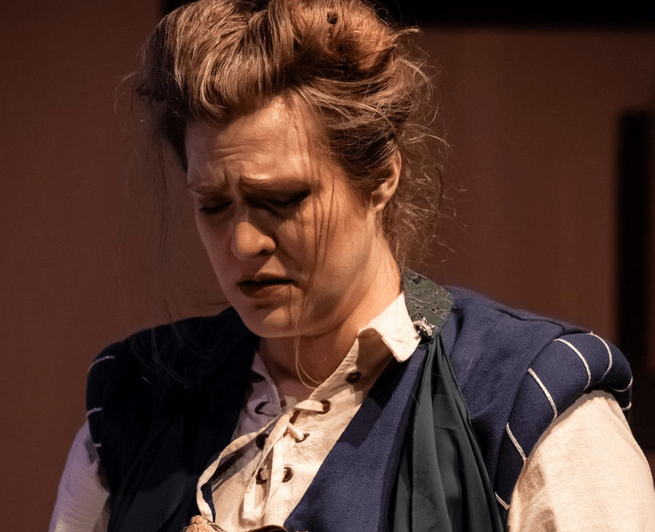
The first act is a rousing adaptation of Richard III aptly titled Richard 3³, which sees all three actors tackle the iconic role and other lead and supporting roles from the original play. This conceit, along with Erfani’s direction, lead to an eerie and exciting switching of the role. In this way, we see a more multi-faceted Richard than if a single actor was playing him: Signe Larsen gives a more gruff and intimidating performance of Richard, Jacquelle Davis leaves us hanging on the edge of our seats, and Mindy Mawhirter’s rendition shows us Richard’s full power of manipulation. When the three are onstage together, speaking and moving as one Richard, Erfani’s direction shines and draws us in completely to Richard’s inner world.
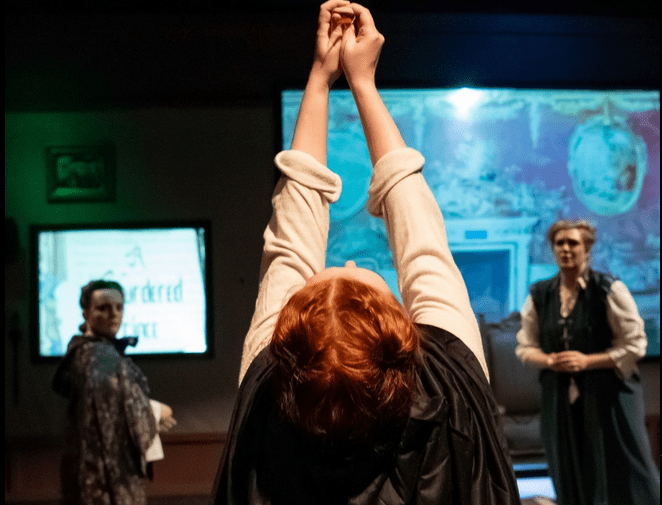
As the actors break in and out of scene, Abby Weinman’s simple costume design paired with Karen Wingard’s props design and Sanford’s scenic design assist the audience along in character changes… and the projected title cards help a lot too, telling us which characters are in scene with one another and where they are. I would be remiss if I didn’t mention how much I loved the eerie sound design of Ash in this show: they perfectly captured the dark political tone of the show with bass reverberations and haunting musical echoes. Overall, Richard 3³ is an exciting, tightly-packed adaptation of the original that stays true to the story’s original intent while subverting classical Shakespearean production expectations.
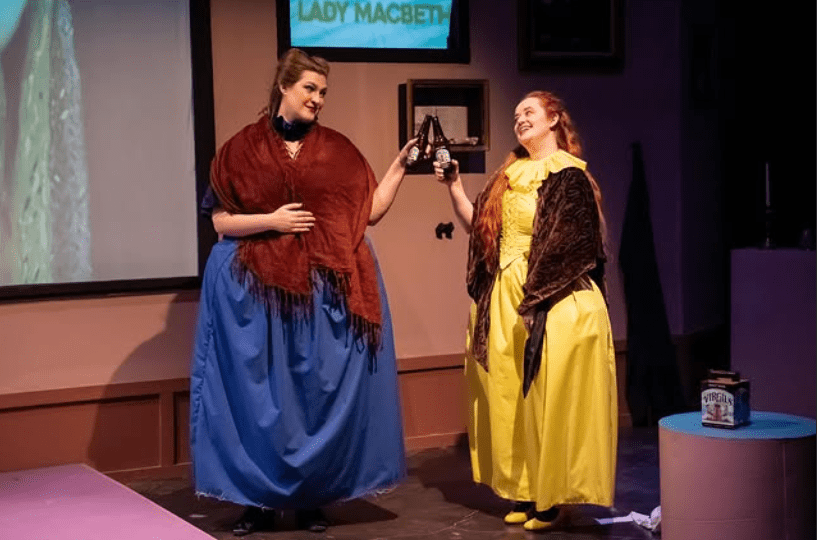
The second act, Femme Endings, deviates away from storytelling in iambic pentameter (though we certainly get a rhythm and grammar lesson in the show) as the three actors take on a large part of diving into the psyches of Shakespeare’s tragic ladies (and also Joan of Arc and Twelfth Night‘s Olivia–interesting choices), as well as “the Dark Lady,” one of Shakespeare’s sonnet muses. This interactive show tears down the fourth wall as actors directly ask the audience for feedback with a coin toss, invite audience members onstage for thumb wars, and even traverse into our ranks to look for mementos in our pockets. These moments keep it fun and lively in between feminist deconstruction of some of the Bard’s famous female characters like Ophelia and Gertrude from Hamlet, Juliet from Romeo and Juliet, Lady M from Macebeth, and many others.
Erfani’s direction and the actors’ quick instincts are what propels the piece forward, as the writing itself doesn’t totally resolve the women’s grievances with their endings and instead acts as both therapy sessions and rants in a supposed afterlife. Still, the script has a charming and meaningful conceit. Femme Endings is an enjoyable, modern take on Shakespeare’s ladies and how many of them deserved better–including in their line count compared to male characters. (Like WOW, Will. Really?)

That said, I couldn’t help but notice that Brown needs to update the definitions of “bisexual” and “pansexual” when we get to Olivia of Twelfth Night‘s monologue on her queer identity and how her Shakespearean ending should be considered tragic (the latter of which I don’t disagree with–Twelfth Night is very gay and should end with Viola and Olivia, just saying). According to lgbtqiacounseling.com,
Pansexuality: A pansexual person is someone who has the potential for emotional, romantic, or sexual attraction to people regardless of their gender identity. This includes potential attraction to individuals who identify as male, female, transgender, genderqueer, nonbinary, or any other gender.
Bisexuality: Bisexuality refers to the potential to be attracted—romantically and/or sexually—to people of more than one gender, not necessarily at the same time, in the same way, or to the same degree. This definition, popularized by bisexual activist Robyn Ochs, suggests that bisexuality includes a wide spectrum of attractions.
It’s important to note that the term doesn’t imply attraction only to two genders (male and female). Despite what the “bi-” prefix might suggest. Instead, it recognizes that there are more than two genders.
Keeping these definitions in mind, the script’s definitions feel antiquated. This does not detract from the whole performance but is worth mentioning for the future of script development.
Overall, Bag&Baggage Productions and Erfani’s show vision absolutely deliver on two fast-paced, wildly different one-acts that pay tribute to the Bard. Go get your fill of scheming royals and feminist rewriting; see the show now until March 8th in Hillsboro, Oregon (right outside of Portland)!
Alyssa Cokinis is a writer and theatre artist from Iowa, currently living in the Pacific Northwest. She is also the founder and editor of some scripts. alyssacokinis.com
Like what you read? Help keep some scripts up and running with a small donation below!
 some scripts