Tag: portland

  • Review: The Words Will Come created by Melody Erfani (LES Shakespeare Co., PDX)

    Review: The Words Will Come created by Melody Erfani (LES Shakespeare Co., PDX)

    When I see friends’ shows with the intention to review, I try to go in as objectively as possible. I will preface this review by saying I’ve read a previous draft of The Words Will Come created by Melody Erfani; what I saw on Saturday, June 6th in Portland proved how much it takes a team like the one Erfani pulled together to create a brilliant show full of heart and intention.

    Amy Driesler (Einstein), Alex Abdelwahed (Sheila), Kelly Saunders (Lala) (left to right).
    Photo by Kyra Sanford

    The Words Will Come blends movement in a dreamscape depicting dyslexia, identity, and searching for one’s voice and belonging. It was inspired in part by Erfani’s own experience with dyslexia as a child, as well as witnessing her niece’s decades later. Erfani was particularly struck by how little structures and institutions have changed in their approach to dyslexic and neurodivergent students. Prior to its world premiere at Shaking the Tree Theatre, Erfani developed the piece at HB Studio in 2024 and the Alembic Residency earlier this year with a slew of collaborators. 

    Immediately upon entering the space, the audience is encouraged to engage with the lobby display about a word that comes to mind about ourselves. There is also a plethora of local and state-wide resources available and some cool swag. I enjoyed being able to be creative and engage in some preshow reflection about dyslexia. It coalesced into a collaborative lobby piece where your word joined others’ to create a new piece of art. 

    Kelly Saunders (Lala), Alex Abdelwahed (Sheila), Amy Driesler (Einstein) (left to right)
    Photo by Kyra Sanford.

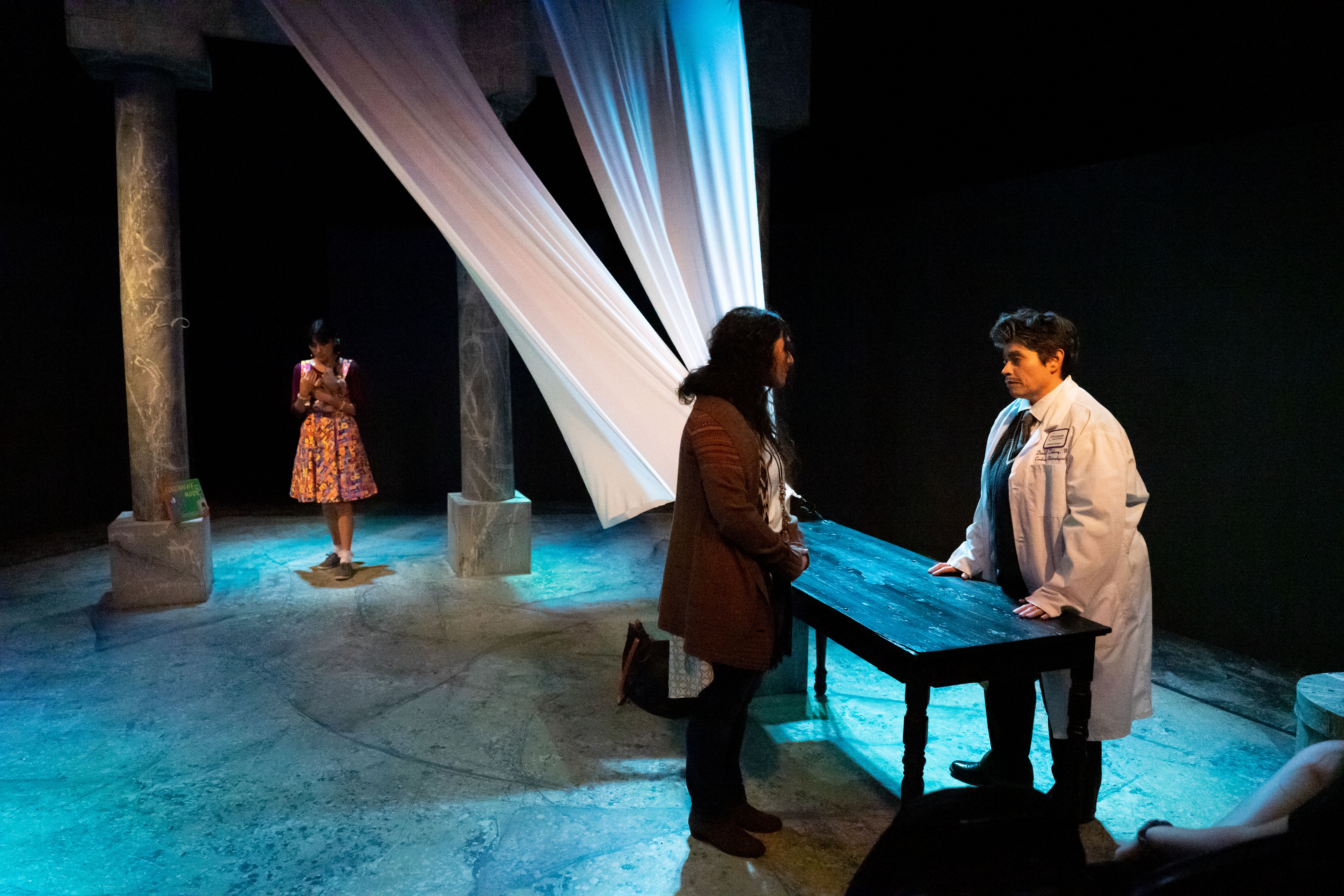
    Erfani’s directing shines once again with a clear vision of storytelling in such a movement-driven piece and in a piece that exists in a more corporeal setting than reality. The set design by Kyra Sanford is sleek and simple, there to accentuate the actors’ interactions and movement and put them on display as if a museum exhibit. Three white columns stand center stage with curtains that are utilized throughout the show to create different scenes, to entrap actors and embody their inner worlds, and to project letters and words onto. Rachel Kinsman Steck’s lighting design and Alan Cline’s projections move seamlessly across the walls of the blackbox and Sanford’s scenery, creating a suffocating feeling that proved most effective when Sheila (our young protagonist played by Alex Abdelwahed) struggles with her dyslexia. 

    Kelly Saunders (Lala), Alex Abdelwahed (Sheila), Amy Driesler (Einstein) (left to right)
    Photo by Kyra Sanford.

    Abdelwahed’s Sheila is endearing, earnest, and fully grounded. She is the life and soul of the piece, bringing together Lala (her older counterpart played by Kelly Saunders) and the one and only Albert Einstein (played by Amy Driesler). Saunders expertly captures the darkness that surrounds an adult losing control of her life as she faces a potential divorce from her wife and as she must relive her childhood memories dealing with dyslexia. Also, major props to Saunders for doing at least three different accents while embodying different characters in Sheila’s world. Driesler’s Einstein surprised me, portraying Einstein not just as the genius we think he was but also embodying him as a full person with a variety of ideas, faults, and emotions. I was really tickled by Einstein playing one of Sheila’s classmates and also Einstein’s soap opera marriage directed by Sheila herself. The three actors work together in the movement portions of the play to create moments of frustration, confusion, fear, love, and acceptance. 

    Amy Driesler (Einstein), Alex Abdelwahed (Sheila), Kelly Saunders (Lala) (left to right).
    Photo by Kyra Sanford.

    I also really enjoyed the moments with Sheila and her mother (also played by Saunders), where their Iranian heritage was subtly present and wholly unapologetic. The “happy birthday” song, followed by Sheila’s unsuccessful wish to know how to read Good Night, Moon and her mother comforting her brought tears to my eyes. In addition, Lala’s casual queerness and her vulnerability around her unraveling relationship with her wife was touching and felt real and organic. As a neurodivergent person, this show made me feel seen. I absolutely adored The Words Will Come and would whole-heartedly see it again. This is what it means to make space for everyone in theatre and storytelling. 

    Kelly Saunders (Lala), Alex Abdelwahed (Sheila) (left to right).
    Photo by Kyra Sanford.

    Performance Details

    THE WORDS WILL COME: Inside the Dyslexic Mind
    Created and directed by Melody Erfani

    When: now through June 28, 2026
    Thursdays–Saturdays at 7:30 PM
    Sundays at 2:00 PM

    *On Saturday, June 20, the show is bringing together educators, dyslexia advocates, immigrant and refugee support organizations, and community leaders for a post-show conversation about belonging, stigma, support systems, and what it means to feel seen. Featuring representatives from: International Dyslexia Association – Oregon, Pacific Refugee Support Group, Wise Choice Educational Solutions, Park Academy, and independent educational advocates

    Where: Shaking the Tree Theatre, 823 SE Grant St. Portland, OR 97214

    Run Time: Approximately 90 minutes

    Tickets: $30 with limited Pay-What-You-Can tickets available
    Tickets available at: www.lesshakespeareco.org


    Alyssa Cokinis is a writer and theatre artist from Iowa, currently living in the Pacific Northwest. She is also the founder and editor of some scripts, which just published its sixth issue, available to purchase and read here.
  • Interview with Creator Melody Erfani on The Words Will Come

    Interview with Creator Melody Erfani on The Words Will Come

    By Alyssa Cokinis

    What if dyslexia were seen as creativity and not as a deficit? 

    The Words Will Come: Inside the Dyslexic Mind by Melody Erfani explores just that. This movement-driven piece follows Sheila, a young Iranian-American girl with dyslexia struggling in school. Movement, sound, projection, and language fracture onstage, translating Sheila’s mind for the audience in an immersive multisensory experience. Within the confines of her mind, Sheila finds an ally in fellow dyslexic Albert Einstein, and she starts to see her dyslexia as something creative and different that brings color to her life and learning. 

    I spoke with Erfani about how the piece was devised, her process, and her hope for audiences once they see the show. 

    Sivan Raz (Sheila) in The Words Will Come by Melody Erfani. Photo by Edison Koo.

    Alyssa Cokinis: How did the concept and themes for The Words Will Come emerge? 

    Melody Erfani: During COVID, I became curious about how my dyslexia affects my day-to-day life as an adult. Other than getting lost very easily, I don’t think about it much now the way I did when I was a kid. I read a book called The Dyslexic Advantage by Brock L. Eide and Fernette F. Eide, which explores the ways dyslexia allows people to see the world differently. I began to recognize how those strengths show up in my theatre work in how I think spatially, visually, and emotionally.

    Shortly after that, my niece Ella, who was eight at the time, began struggling in school. I was struck by how many of the same challenges still exist and how little has changed in 30+ years. It reminded me of a specific childhood memory, sitting in an English lesson on tenses or prepositions that made absolutely no sense to me. I remember looking over at another student’s paper because everyone else seemed to understand, and I didn’t. It felt like the teacher was speaking a completely different language, and I was on the outside looking in.

    That feeling of confusion, isolation, and trying to make sense of something that isn’t built for you became a central emotional thread in the piece. I wanted to provoke conversation about our learning systems, offer a sense of hope, and illuminate the richness and complexity of the neurodivergent experience.

    Cerra Cardwell (Lala), Sivan Raz (Sheila), and Getchie Argetsinger (Einstein) (left to right) in The Words Will Come. Photo by Edison Koo.

    Cokinis: This is the world premiere of the play after two development residencies (congrats!!). How has each residency shaped the trajectory of the piece?

    Melody Erfani: The piece began with an idea and a lot of research, but I initially felt stuck. I ended up creating my own mini writing residency, working with Jonathan Cullen, Rebby Foster, and Cynthia Petts. We met once a week over six weeks, and that process helped me through brainstorming, improvisations, and informal readings of the piece. 

    Those few scenes of material became the foundation for the HB Studio Residency in February 2024. That phase was a staged workshop where a rough draft of the script was developed further, collaborating with designers to add layers to the experience. We had four free public performances followed by talkbacks. Hearing directly from audiences helped me identify what was resonating and what needed to be reworked.

    Most recently, I was in the Alembic Residency, which focused more on allowing rehearsal space for exploration of physical movement. That was instrumental, especially since movement plays such a key role in the piece. Working with other artists and receiving feedback on the physical storytelling has helped clarify the narrative in a much more embodied way.

    Cerra Cardwell (Lala), Sivan Raz (Sheila), and Getchie Argetsinger (Einstein) (left to right) in The Words Will Come. Photo by Edison Koo.

    Cokinis: How does movement drive the story of your play and the relationships between characters, as well as their relationship to dyslexia? 

    Melody Erfani: Movement is used to express shifts in time, confusion, distortion, and moments of overwhelm or chaos. It allows us to move beyond literal storytelling and into a more experiential space. Rather than explaining what’s happening inside the main character’s mind, movement gives the audience a way to feel it alongside her. It creates a shared sensory experience, one that mirrors the nonlinear, sometimes disorienting, but also imaginative and expansive nature of dyslexia.

    Theatre, for me, is the right medium for that because it’s inherently collaborative and immediate. The audience is right there, breathing the same air as the actors. There’s something about that shared space – the vibrations, the breath that creates an experience you can’t replicate elsewhere. It allows the audience not just to observe, but to physically and emotionally enter the world of the play.

    Sivan Raz (Sheila) and Getchie Argetsinger (Einstein) (left to right)  in The Words Will Come.
    Photo by Edison Koo.

    Cokinis: What are you most excited about with this next iteration of The Words Will Come? 

    Melody Erfani: From the beginning, the design elements have always been an essential layer of the piece. Even while writing, I was imagining how projection, sound, and movement would interact with the story. While our budget is modest (and there are always limitations that come with that), the design team we’ve assembled is incredibly creative and thoughtful. I’m excited to see how their artistry deepens the world of the play and transforms it into a more immersive, multi-sensory experience.

    Cokinis: What do you hope audiences walk away thinking or feeling?  

    Melody Erfani: Empathy. Children between the ages of 7–12 often struggle the most with dyslexia. Our education system is so heavily rooted in reading that if a child struggles to read, it impacts every subject. One challenge compounds another, and many kids end up feeling left behind. There are sobering statistics around students not graduating and the school-to-prison pipeline, where a significant portion of the incarcerated population have learning differences.

    Sivan Raz (Sheila) and Getchie Argetsinger (Einstein) (left to right)  in The Words Will Come.
    Photo by Edison Koo.

    At the core of it, I want audiences to leave asking: how can we better see, support, and advocate for these kids? And how can we begin to shift the narrative from deficit to difference?

    There’s also a thread of hope in the piece, embodied in the character of Einstein. He represents possibility. He’s someone widely recognized as a genius, and he was dyslexic. Even as a child, knowing that gave me a sense of hope that there was another way to think, another way to be, and that difference could be a strength.

    Performance Details

    THE WORDS WILL COME: Inside the Dyslexic Mind
    Created and directed by Melody Erfani

    When: June 4–28, 2026
    Thursdays–Saturdays at 7:30 PM
    Sundays at 2:00 PM

    Where: Shaking the Tree Theatre
    823 SE Grant St
    Portland, OR 97214

    Run Time: Approximately 90 minutes

    Tickets: $30 with limited Pay-What-You-Can tickets available

    Tickets available at: www.lesshakespeareco.org


    Alyssa Cokinis is a writer and theatre artist from Iowa, currently living in the Pacific Northwest. She is also the founder and editor of some scripts, which just published its sixth issue!