Tag: new plays

  • An Interview with Playwright Alyssa Cokinis on In Memory Of

    By Melody Erfani

    In a world where memories can be traded like currency, what would you be willing to give up just to survive?

    In Memory Of, written by Alyssa Cokinis, directed by Pax Bennett, and presented by Spark Plug Theatre Collective, imagines a dystopian future where identity, grief, and resistance collide. Set in the aftermath of a civil war, the play explores a society where survival comes at the cost of one’s own memories—raising urgent questions about autonomy, surveillance, and what it means to remain human in an increasingly transactional world.

    I spoke with Cokinis about the origins of the play, its emotional landscape, and what she hopes audiences will carry with them long after the performance ends.


    Melody Erfani: In Memory Of is such an evocative title—what first sparked the idea for this piece?

    Alyssa Cokinis: In Memory Of was first conceived in 2018 during a time of major personal and professional transition. I was grappling with the idea of commodifying my time and identity just to survive—whether that was through day jobs or trying to gain recognition in the arts.

    I’ve always been drawn to dystopian storytelling—The Hunger Games and The Giver were huge influences growing up. I started wondering: what if, instead of money, we had to pay with memories—parts of ourselves—in order to live? That idea stayed with me for years.

    I revisited the play in 2025, while witnessing ongoing global crises and thinking deeply about how memory is documented, erased, and controlled. It became clear to me there was still more to say.

    Actors Nicki Darling (L) and Matthew Grand (R) portray characters Vale and Dom. Darling (shoulder-length curly dark brown hair, pale complexion) as Vale wears a blue plaid flannel and blue jeans with brown boots, looking concerned. Grand (short blonde hair, pale complexion) dons all black and is gesturing their right hand up.

    Melody Erfani: Without giving too much away, what kind of world are you inviting audiences into?

    Alyssa Cokinis: The play takes place in a post–civil war United States where lawmakers have implemented something called the Memory Currency Act. The idea is that by paying in memories instead of money, everyone is on equal footing—but of course, that’s not really true.

    We follow Vale, who has returned to the U.S. after living abroad and is navigating grief, displacement, and the cost of survival. They’re isolated, struggling, and questioning the system around them.

    While the emotional landscape is dark, there are also moments of humor, connection, and hope. At its core, the play is about relationships—how people care for each other, resist together, and find humanity even under surveillance.

    Actors Nicki Darling (L) and Tate Ivy (R) portray characters Vale and Laurel. Darling sits on a bench with a hand up to their face, laughing, while Ivy (wearing a keffiyah wrapped around their head with short red hair peeking out, pale complexion) dons all black and stands with their arms out, imitating something. A black and grey backpack sits on the bench next to Darling and in front of Ivy.

    Melody Erfani: What themes or questions are at the heart of the play for you right now?

    Alyssa Cokinis: I keep coming back to questions like: What does it mean to live in a surveillance state? What is “real” in an age of generative AI? Who owns our memories and lived experiences?

    The play also explores queerness, identity, grief, resistance movements, and the cost of freedom. It asks whether small, individual actions can make a difference against systems that feel overwhelming—and whether collective action can truly create change.

    Actors Tate Ivy (L) and Nicki Darling (R) portray characters Laurel and Vale. In this photo Ivy dons a blue shirt with grey horizontal strips. Ivy and Darling have their pinky fingers locked in a promise as they sit on black cubes.

    Melody Erfani: Has anything surprised you in the development process?

    Alyssa Cokinis: Absolutely. The characters have deepened so much through rewrites and collaboration with actors. I also found myself adding more humor than I initially expected—it became essential to balancing the weight of the story.

    One of the biggest surprises was introducing a fifth character who appears late in the play but reshapes how we understand everything that came before.

    A photo in bluelight of a projection with green and white coding.

    Melody Erfani: How has working with Spark Plug Theatre Collective and the Fertile Ground Festival shaped the piece?

    Alyssa Cokinis: Spark Plug Theatre Collective has been an incredible partner. Their WRITE | IGNITE initiative is designed to support new plays through workshop-style productions, and being part of its inaugural cohort has been really meaningful.

    The team—our dramaturg Amanda Clark, director Pax Bennett, and actors—have asked thoughtful, challenging questions that have helped expand the world and deepen the characters. And the intimate space at Ki Coffee allows the audience to be right there with the actors, which is exactly what this story needs.

    Actors Nicki Darling (L) and Anita Rohira (R) as characters Vale and Kandala. Darling stands looking serious, and Rohira (brown and pink highlighted shoulder-length hair, brown complexion), wearing blue jeans and a purple/yellow/green vertical striped top, looks at Vale while mid-sentence. Both stand in front of a projection of the Hawa Mahal of Jaipur, India.

    Melody Erfani: What do you hope audiences walk away thinking or feeling?

    Alyssa Cokinis: Things are bleak right now—and they may continue to be—but there are always pockets of joy and resistance that we have to actively choose.

    Hold your people close. And fight like hell.


    Performance Details

    In Memory Of runs April 10–12 at 7:30 PM at Ki Coffee in Beaverton, Oregon.

    Run time is approximately 90–95 minutes.

    Tickets are $15, with pay-what-you-will options available. Seating is limited to 24 audience members per performance.

    Tickets: https://sparkplugtheatrecollective.ludus.com/index.php?show_id=200520809


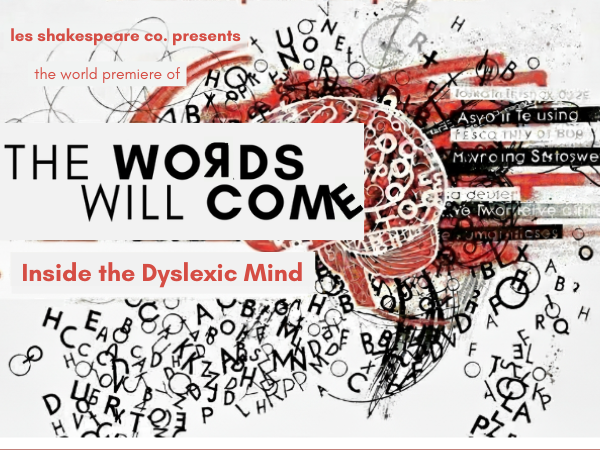
    Melody Erfani is a theatre creator and director and the founding artistic lead of LES Shakespeare Co. Her work blends movement, new writing, and classical adaptation to illuminate untold stories, often centering immigrant and neurodivergent experiences. Recent projects include Bee زنبور97 Orchard Street, and The Words Will Come, an immersive memory play about dyslexia. She holds an MFA in Directing from the Actors Studio Drama School and has trained with the Lincoln Center Directors Lab and Shakespeare’s Globe. She has also received residencies at HB Studios 2017, 2024, Barns Art Collective, Drama League First Stage Residency, and Osleth Family Foundation.  www.melodyerfani.com


    Email somescriptslitmag@gmail.com if you’d like to contribute a theatre review or artist interview from the city you’re in!

  • 3 Oregon Theatre Mini-Reviews: Summer 2025

    3 Oregon Theatre Mini-Reviews: Summer 2025


    Summer 2025 was a summer of theatre for me! From Portland to Salem, there was consistently great work being done to show a thriving theatre scene looking toward the future while paying homage to the past.

    Here are three shows I saw that pushed boundaries and were entertaining–for better or worse.

    The Importance of Being Earnest by Oscar Wilde (Portland Center Stage, Portland)

    In June a friend and I made our way up to Portland to see The Importance of Being Earnest at Portland Center Stage, directed by Josiah Davis. With a love for Oscar Wilde, we expected a fun experience reminiscent of previous Earnest productions. What we got was so fun and more overtly gay! Hooray!

    Photo by Jingzi Zhao

    This production was derived from a new adaptation of Oscar Wilde’s original play by Kamilah Bush, the literary manager at PCS. Without sacrificing the commentary on Victorian-era ideals, Bush pushed the show’s setting up to the 1920s and from England to Washington, DC. While it wasn’t always clear why there was a need to replant the show in a different time and setting, Bush’s adaptation is still overall a resounding success in its commentary on queer identity, love, and acceptance.

    This adaptation played with the idea of Jack and Algernon plus Gwendolen and Cecily eventually coming to the idea to end up in lavender marriages. This clever twist gave us an all-new scene between Cecily and Gwendolen and played up the theatrics between the hetero pairings prior to the stand-off with Lady Bracknell. Each actor committed entirely to their role and brought about a perfect show for Pride Month.


    We’re All Gonna Make It (W.A.G.M.I.) by AR Nicholas (Theatre 33, Salem)

    Theatre 33 is a staple summer theatre festival in Salem, Oregon (the capital, about a one hour drive south of Portland). The festival format of Theatre 33 lends itself to workshop productions of new plays, as well as staged readings of others, chosen from an open submission process each year. According to the theatre’s mission, it is a “professional new play development company in residence at Willamette University… dedicated to advancing Oregon and NW artists, playwrights, history, and culture.” While I wasn’t able to make it to most of the other shows in their festival unfortunately, I did get to see W.A.G.M.I., written by AR Nicholas and directed by Elizabeth Rothan, which gave a lot of food for thought.

    Nicholas’ play is a play in the near future (or now) about a couple who are navigating the different ways surveillance infects their lives. The husband Nick is under house arrest, being investigated for fraud. The wife Jocelyn is slowly losing her grip on reality the longer she finds herself possibly being stalked by a figure in a trench coat.

    The workshop of this play showed the potential it has. Actors Devika Danish Dhamija and Parth Ruparel showed a commitment to portraying their relationship as a married couple as organically as possible. Ruparel particularly excelled, coming in and out of each scene with ease, given circumstances clearly embodied in how he portrayed Nick. The actors did a fantastic job, and the projection design by Tim Cowart was particularly effective, embedding the audience in this living room play surveillance state nightmare.

    The writing lacks somewhat in cohesion, and that shows in the overall directorial vision of the play. Despite the play going through the development process with Theatre 33, the audience is left with more questions than answers–and not necessarily in the satisfying way–at the end of the play. Dhamija and Ruparel do their best with what they’re given. The play could stand as a two-hander without the inclusion of the third trenchcoat-wearing stalker also, seeing as we get plenty of that character through projection and not enough of them onstage to justify their physical presence.

    Overall, Theatre 33 is doing important work for new plays, though it would be cool to see less PDX-based artists involved and more inclusion of theatre artists local to Salem and its surrounding areas. Otherwise, the festival might as well happen in Portland for the sake of the actors commuting.


    Hairspray (Pentacle Theatre, Salem)

    While this was my first time seeing a show at the Salem community theatre, it was certainly the one I was most interested in seeing. Pentacle Theatre, a staple of Salem since 1954, is the community theatre of the city. Despite being the capital city of Oregon, Salem does lack in a truly robust arts scene, though there is a lot of movement to change that. Pentacle Theatre works to fill that gap, and their production of Hairspray was not one to miss (so sorry if you did!).

    Hairspray (by Mark O’Donnel and Thomas Meehan [book], Scott Wittman [lyrics], and Marc Shaiman [music & lyrics]) is a fun musical with campy songs and dances, and its significance in blatantly discussing civil rights rings true even in 2025. As we watch the erosion of people’s rights in the United States under a right wing, openly fascist government, productions like Hairspray that show a community coming together to fight for one another, to fight for inclusion, and to fight for love in spite of racism and discrimination.

    Photo by Vicki Woods

    Jessica Peterson as Maybelle Motormouth received a rightfully deserved standing ovation for her honest and simple rendition of “I Know Where I’ve Been”; Paige Caballero as Tracy Turnblad, Mason Fuller as Seaweed, Michael Louladkis as Edna Turnblad, Olivia McCoy as Little Inez, Trevor J. Olson as Link Larkin, Natalie Pate Gwin as Penny Pingleton, Peterson as Maybelle, and the entire ensemble round out to perhaps the most professional-level production seen in Salem for the last few years. It’d be cool for Pentacle to pay their talented casts even a small stipend, especially with a powerhouse cast like Hairspray.

    Major props need to be given to director Robert Salberg, assistant director Deborah Johansen, music/vocal director Kent Wilson, and all of the designers for a very sleek, fun production that will tug on your heartstrings. Hairspray is the kind of theatrical production Salem needs more of.


    Want me to review a show in Oregon or the Pacific Northwest? Email somescriptslitmag@gmail.com with a press comp invitation, and I will happily come see your show and write a review!


    Alyssa Cokinis is a writer and theatre artist from Iowa, currently living in the Pacific Northwest. She is also the founder and editor of some scripts.


    Like what you read? Help keep some scripts up and running with a small donation!

  • Review: Beginnings and Endings by Sarah Lynn Brown at Bag&Baggage Productions (Portland, OR)

    Review: Beginnings and Endings by Sarah Lynn Brown at Bag&Baggage Productions (Portland, OR)

    written by Alyssa Cokinis

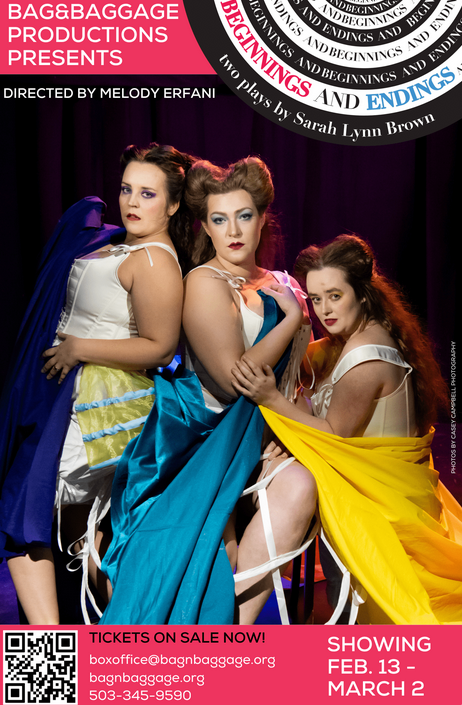
    After delaying opening night due to ice and snow, Beginnings and Endings by Sarah Lynn Brown, directed by Melody Erfani, opened at Bag&Baggage Productions in Hillsboro (just outside of Portland) on February 16, 2025. Bag&Baggage describes the show as “continuing its tough love affair with Shakespeare,” though it more than continues–the show is overall a wonderful success and tribute to the Bard.

    Beginnings and Endings is actually two one-act plays by playwright Sarah Lynn Brown that have little in common with each other. However, Erfani’s smart framing of the shows as two museum exhibits, reflected in everything from Kyra Sanford‘s scenic design down to the actors serving as museum tour guides at pre-show, sets the audience up well for what to expect in the coming two hours.

    Actor Signe Larsen in deep, distraught contemplation. Photo by Casey Campbell Photography.

    The first act is a rousing adaptation of Richard III aptly titled Richard 3³, which sees all three actors tackle the iconic role and other lead and supporting roles from the original play. This conceit, along with Erfani’s direction, lead to an eerie and exciting switching of the role. In this way, we see a more multi-faceted Richard than if a single actor was playing him: Signe Larsen gives a more gruff and intimidating performance of Richard, Jacquelle Davis leaves us hanging on the edge of our seats, and Mindy Mawhirter’s rendition shows us Richard’s full power of manipulation. When the three are onstage together, speaking and moving as one Richard, Erfani’s direction shines and draws us in completely to Richard’s inner world.

    Actor Mindy Mawhirter (C), back to viewer and arms raised, with actors Jacquelle Davis (L) and Signe Larsen (R) flanking and looking on. Photo by Casey Campbell photography.

    As the actors break in and out of scene, Abby Weinman’s simple costume design paired with Karen Wingard’s props design and Sanford’s scenic design assist the audience along in character changes… and the projected title cards help a lot too, telling us which characters are in scene with one another and where they are. I would be remiss if I didn’t mention how much I loved the eerie sound design of Ash in this show: they perfectly captured the dark political tone of the show with bass reverberations and haunting musical echoes. Overall, Richard 3³ is an exciting, tightly-packed adaptation of the original that stays true to the story’s original intent while subverting classical Shakespearean production expectations.

    Actors Signe Larsen and Mindy Mawhirter clanking root beers onstage in Femme Endings. Photo by Casey Campbell Photography.

    The second act, Femme Endings, deviates away from storytelling in iambic pentameter (though we certainly get a rhythm and grammar lesson in the show) as the three actors take on a large part of diving into the psyches of Shakespeare’s tragic ladies (and also Joan of Arc and Twelfth Night‘s Olivia–interesting choices), as well as “the Dark Lady,” one of Shakespeare’s sonnet muses. This interactive show tears down the fourth wall as actors directly ask the audience for feedback with a coin toss, invite audience members onstage for thumb wars, and even traverse into our ranks to look for mementos in our pockets. These moments keep it fun and lively in between feminist deconstruction of some of the Bard’s famous female characters like Ophelia and Gertrude from Hamlet, Juliet from Romeo and Juliet, Lady M from Macebeth, and many others.

    Erfani’s direction and the actors’ quick instincts are what propels the piece forward, as the writing itself doesn’t totally resolve the women’s grievances with their endings and instead acts as both therapy sessions and rants in a supposed afterlife. Still, the script has a charming and meaningful conceit. Femme Endings is an enjoyable, modern take on Shakespeare’s ladies and how many of them deserved better–including in their line count compared to male characters. (Like WOW, Will. Really?)

    Actors Jacquelle Davis, Mindy Mawhirter, and Signe Larsen. Photo by Casey Campbell Photography.

    That said, I couldn’t help but notice that Brown needs to update the definitions of “bisexual” and “pansexual” when we get to Olivia of Twelfth Night‘s monologue on her queer identity and how her Shakespearean ending should be considered tragic (the latter of which I don’t disagree with–Twelfth Night is very gay and should end with Viola and Olivia, just saying). According to lgbtqiacounseling.com,

    Pansexuality: A pansexual person is someone who has the potential for emotional, romantic, or sexual attraction to people regardless of their gender identity. This includes potential attraction to individuals who identify as male, female, transgender, genderqueer, nonbinary, or any other gender.

    Bisexuality: Bisexuality refers to the potential to be attracted—romantically and/or sexually—to people of more than one gender, not necessarily at the same time, in the same way, or to the same degree. This definition, popularized by bisexual activist Robyn Ochs, suggests that bisexuality includes a wide spectrum of attractions.

    It’s important to note that the term doesn’t imply attraction only to two genders (male and female). Despite what the “bi-” prefix might suggest. Instead, it recognizes that there are more than two genders.

    Keeping these definitions in mind, the script’s definitions feel antiquated. This does not detract from the whole performance but is worth mentioning for the future of script development.

    Overall, Bag&Baggage Productions and Erfani’s show vision absolutely deliver on two fast-paced, wildly different one-acts that pay tribute to the Bard. Go get your fill of scheming royals and feminist rewriting; see the show now until March 8th in Hillsboro, Oregon (right outside of Portland)!


    Alyssa Cokinis is a writer and theatre artist from Iowa, currently living in the Pacific Northwest. She is also the founder and editor of some scripts. alyssacokinis.com

    Like what you read? Help keep some scripts up and running with a small donation below!